
Marin Monarch Working Group
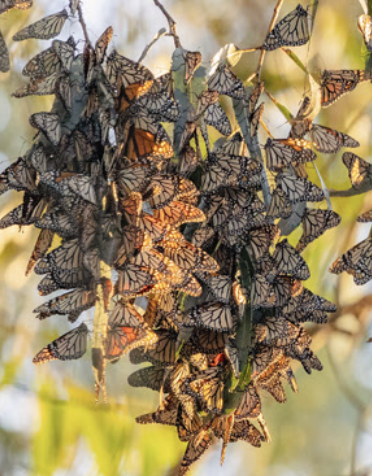
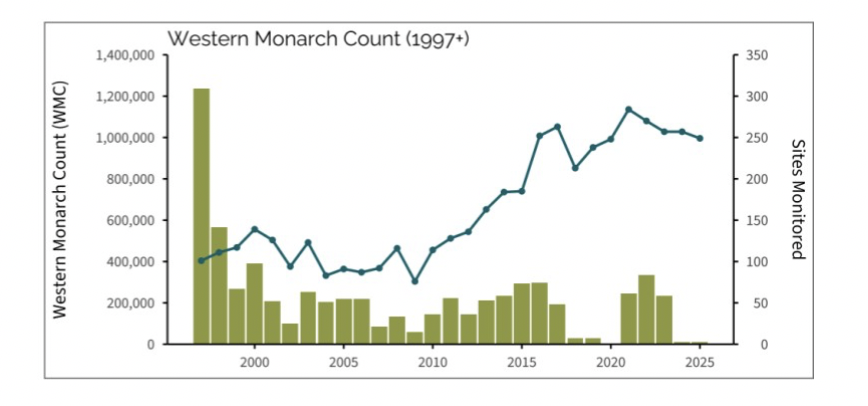
Western monarch butterflies used to be a common sight in Marin and elsewhere throughout California. But the Western monarch population in the US has declined by more than 95% since the 1990s.
The recent 29th Western Monarch Count confirmed this ongoing trend toward extinction.
Approximately 12,260 monarchs were recorded, the third-lowest tally since the count began in 1997.
Causes of this decline include climate change, habitat loss, natural predators, and pesticide use.

It’s not too late to act…but the time to act is now!
Who We Are
The Marin Monarch Working Group was established in 2019 to address the existential crisis facing the western monarch, one of California’s most iconic creatures.
We call on educators, biologists and botanists, gardeners and monarch lovers to join us and learn how to become involved in supporting the survival of the Western monarch butterfly.

Public Education and Advocacy
We disseminate science-based information about monarchs via our newsletter, website, social media, on-line meetings, and tabling at local events. We guide local residents’ outreach to local and state officials about policies and practices for helping monarchs.

Community Science
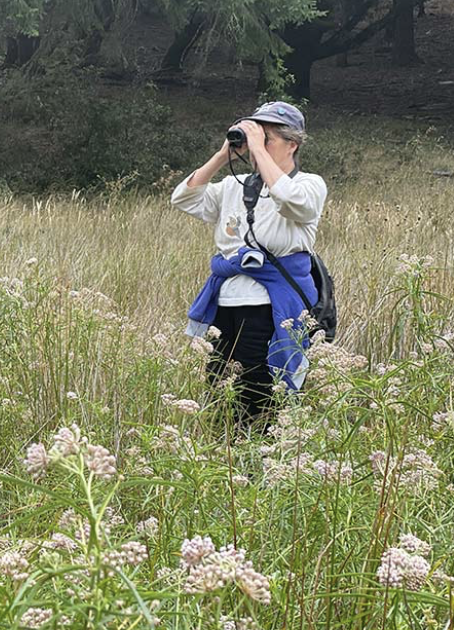
Community science draws upon data collected by community members trained to observe and create a record of their observations. We connect local monarch lovers with training and monitoring opportunities led by MMWG co-founder, Mia Monroe.
Habitat Restoration
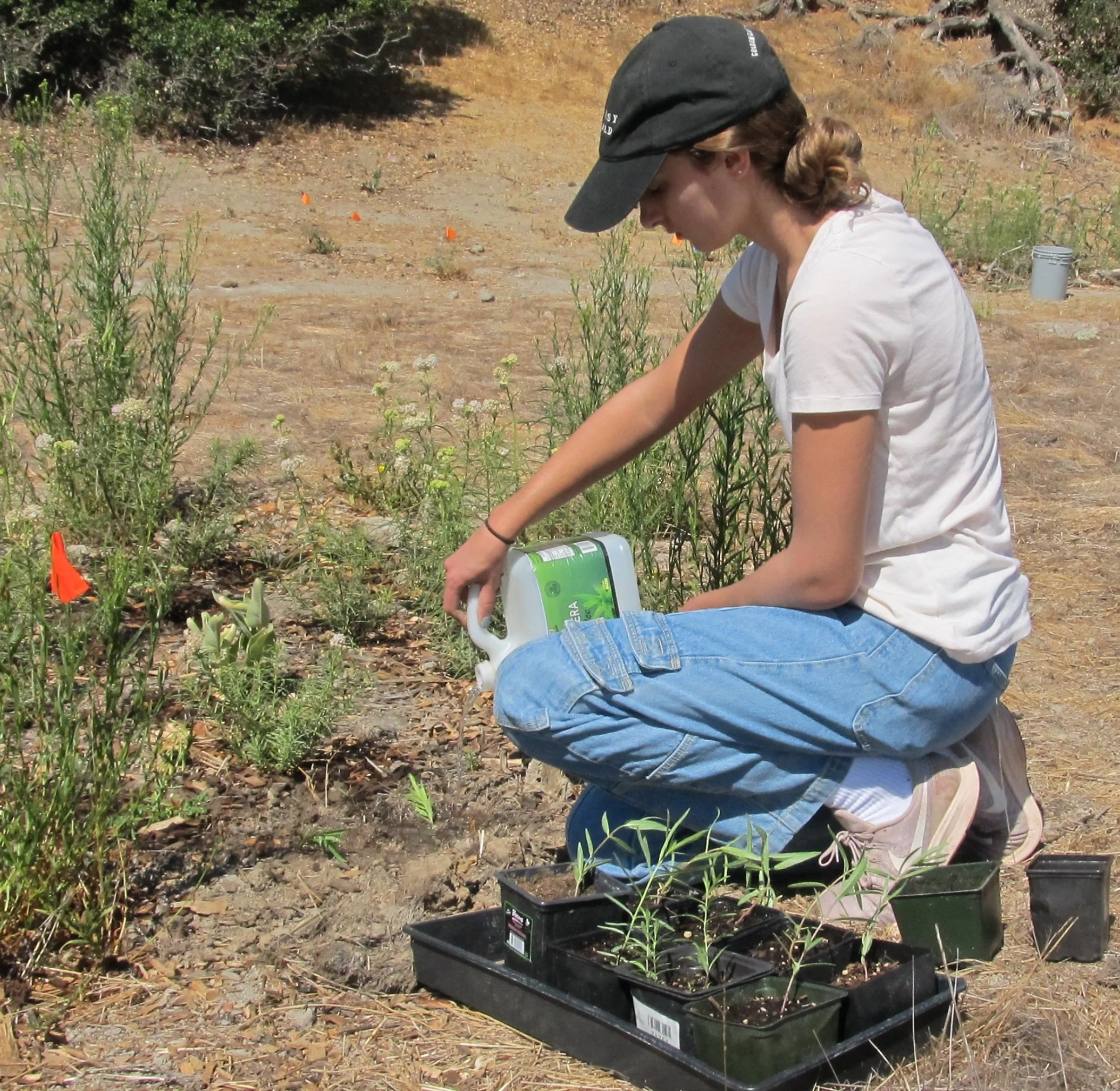
We take on projects to create and restore monarch habitats in private and public spaces. And we work with other groups engaging in this important work.
Three Things You Can Do to Help the Monarchs
First way to help: Create the right habitat for monarchs
If you have any yard space — large or small — you can create an oasis for monarchs as they migrate east in the summer and return to the coast in the fall.
One important point to keep in mind as you work on your garden: Be sure to avoid pesticides!! Pesticide use is another serious threat to monarch survival.
Check out these handouts for some ideas on how to get started. The Home Gardens section of this website gives lots more guidance on the whole process.
Backyard Garden Plants for Inland areas. This guide provides information about 16 nectar-rich plants whose flowers bloom from early spring through fall.
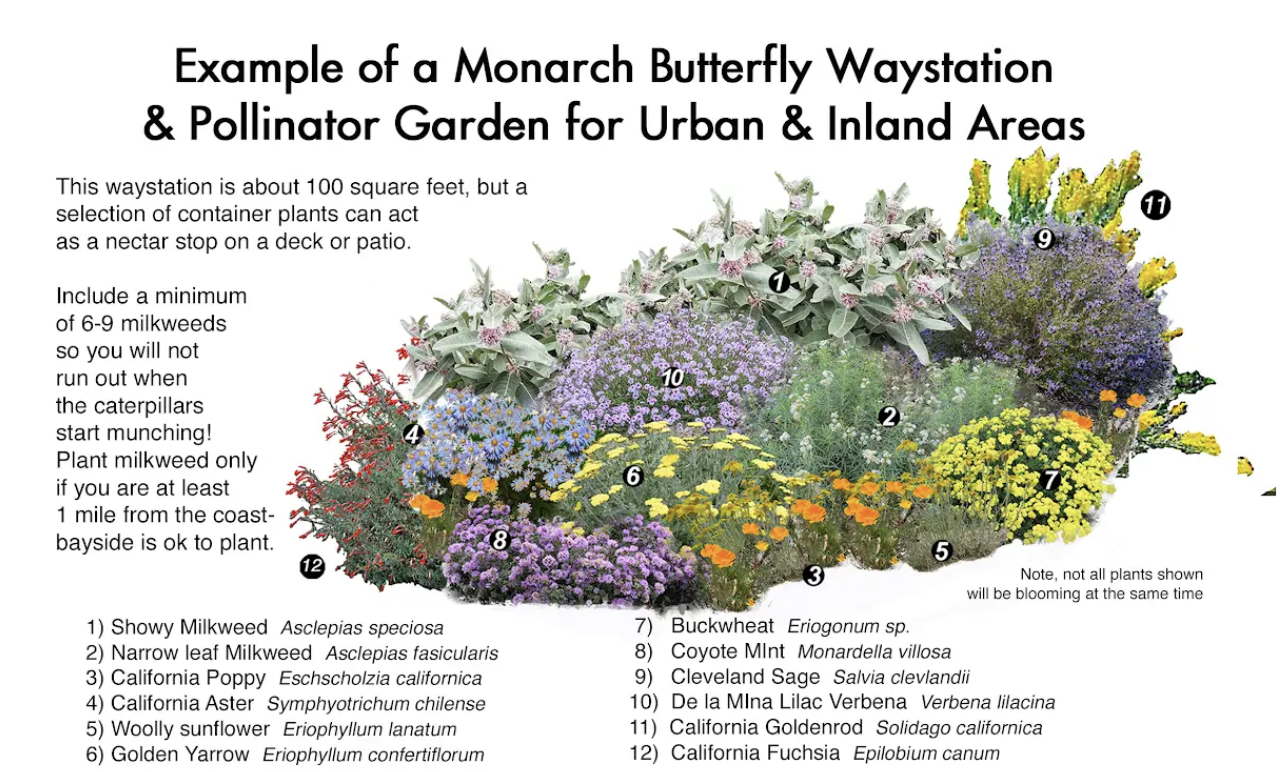
Example of a Butterfly Waystation and Pollinator Garden. This handout will show you how to design a garden for butterflies migrating through the county. You’ll see 12 plants that they really like, along with information about growing native milkweed from seed.
Help Monarch Butterflies in Coastal Marin by Planting Fall and Winter Blooming California Native Nectar Plants. If you live within a mile of the coast, the planting routines are different than those appropriate for inland residents. In the winter, monarchs are in a period of diapause. That is, they are resting and are not supposed to be reproducing. So they only need nectar plants that bloom in late fall, winter, and early spring. And they do NOT need milkweed, because they are not supposed to bringing caterpillars into the world until they migrate inland during the spring.
Another important way to create and maintain habitat for monarch butterflies is to participate in community garden projects. There are lots of local groups working on these projects. Go to the Resources section of this website to learn what is going on in Marin.
Second way to help: Participate in the 30th annual Western Monarch Count!
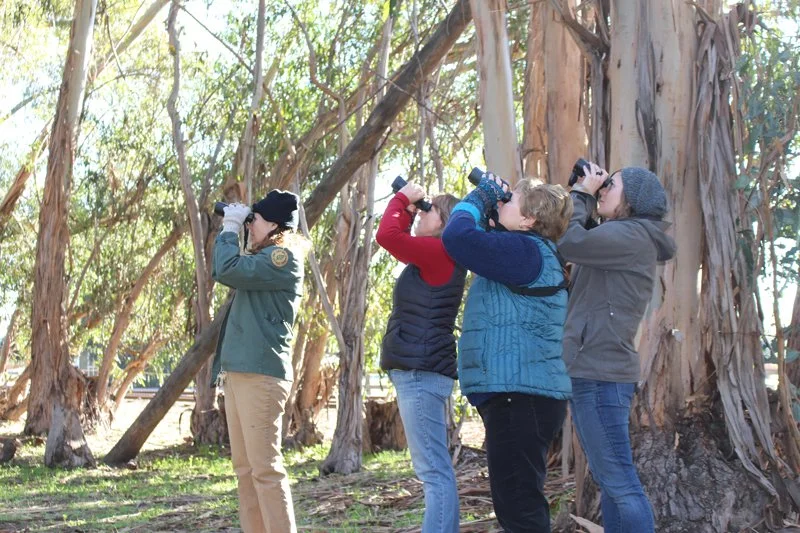
Helping the monarchs depends on having good information about where they are in the county and what they are doing. Habitat restoration and policy recommendations rely on data collected by community members trained to observe the monarchs and create a record of the observations.
The Western Monarch Count (WMC) occurs at three times during the fall and winter. In 2026, the early-season count extends from October 17 to November 1. The mid-season count begins on November 14 and ends on December 6, and the late-season count goes from December 26 to January 10.
The WMC is an intensive community science project geared for participants who can commit a minimum of 12 to 15 hours each fall and winter. Volunteers must attend virtual and in-person field training, provide personal transportation, follow survey protocol, navigate uneven outdoor terrain, and submit data electronically using a smartphone, tablet, or computer.
HERE’S HOW YOU CAN BECOME INVOLVED: Sign up for the on-line training offered by the Xerces Society. To sign up go to their website: https://westernmonarchcount.org/volunteer/
When you have completed the training, your name will be sent to Mia Monroe, coordinator of the Count. She will add you to a team if support is needed.
If you can’t commit to the training, you can also make a visit on your own to see monarchs and/or volunteers in action. To prepare for your visit, check out this information from Xerces: https://xerces.org/blog/everything-you-need-to-know-about-visiting-overwintering-monarchs.
The Marin team will set aside a few days for public viewing with support from the Count team. If you haven’t already done so, go the bottom of this page and put your name on the Marin Monarch Working Group mailing list. Then you will receive the MMWG Newsletter and other info about these opportunities.
Third Way to Help: Advocate for Policies to Help Monarchs
The Western monarch population has declined by more than 95% since the 1990s. This graph of data from the most recent Western Monarch Count by Xerces confirmed this ongoing trend toward extinction.
The US government has not yet taken legislative action to protect the monarch
In December of 2024, the US Fish and Wildlife Service (USFWS) proposed to list the monarch butterfly as a threatened species under the Endangered Species Act. The Department of the Interior was expected to finalize a listing within one year of proposing it but did not do so.
The orange-and-black butterflies were set to be protected as threatened under the Endangered Species Act in December 2025, but the Trump administration failed to finalize protections for them. That led to a lawsuit from the Center for Biological Diversity and Center for Food Safety, and agreement was reached in September of 2026.
In a bittersweet move for conservation groups, the U.S. Fish and Wildlife Service agreed to issue a final listing determination for monarch butterflies…by June 6, 2030. This delay is disappointing given the perilous condition of the western monarch.


It should also be noted that the overall effectiveness of federal protection for any species listed as endangered worsened significantly in July of 2026, when the Trump administration rescinded the “harm rule” under the Endangered Species Act. The original law prohibited injuring or killing wildlife as well as destroying protected habitats. Under the new rule, destroying those habitats is no longer illegal, paving the way for drilling, mining, and other activities in protected wildlife habitats. action is also crucial.
Bills have been introduced in the House and Senate to stop the ESA “Harm” rule.
Representatives Brian Fitzpatrick of Pennsylvania and Mike Quigley of Illinois have introduced the bipartisan Safeguarding Endangered Species Act (H.R. 9901). This bill would stop the ESA “Harm” rule and preserve longstanding protections against habitat destruction that kills or injures imperiled wildlife.
In the Senate, Senators Adam Schiff of California and Sheldon Whitehouse of Rhode Island have introduced S.J. Res. 204, a Congressional Review Act resolution that would also stop the new rule. Unlike most legislation, Congressional Review Act resolutions can pass the Senate with only a simple majority vote, giving lawmakers a clear path to reversing this harmful change.
You can speak out to help stop the ESA “Harm” rule. Tell Congress: Overturn the ESA “Harm” rule. Support H.R. 9901 and S.J. Res. 204. Defend the habitat protections that species need to survive and recover.
At the state level, Representative Dawn Addis introduced AB 2254, the Coastal Monarchs Protection Act. This bill would have required communities along the coast with monarch butterfly winter habitat to create policies to protect this iconic and important species. However, the bill did not pass out off the appropriations committee in time to be acted upon this year.
JOIN US! Sign up below for our mailing list to receive our monthly newsletter for up-to-date information on the monarchs’ status and suggestions for actions you can take to safeguard their welfare. We will let you about local habitat restoration projects, citizen science opportunities, and ways to advocate at the county, state, and national levels.
WE WELCOME DONATIONS TO SUPPORT OUR WORK. The MMWG is a registered 501c3 nonprofit organization and your donations are tax deductible. Our EIN number is 41-4705785.
Donated funds are used to cover purchases like plants for restoration projects and materials for the production of our handouts.
To contribute, send a check made out to the Marin Monarch Working Group to PO Box 242, Inverness CA 94937.
Or click on the Donate button below.